At four-fifteen in the morning, the bells came past the window. Not loudly — the sound was soft, almost hesitant, the way a large group of animals moves when it doesn't want to wake the valley. But there were hundreds of them, and the sound lasted several minutes, and by the time it faded I was fully awake and sitting up in the dark in my grandfather's guesthouse in Theth, listening to the silence that came after.
This is the shepherd's hour. The flock leaves for the high pasture before dawn, before the heat, before the tourists who have come to walk the Valbona-Theth pass fill the trail. By the time anyone else is awake, the sheep are already somewhere above the treeline, already grazing, already irrelevant to the day's itinerary.
Getting there
Theth is three hours from Shkodra by a road that was mostly unpaved until a few years ago and is now paved in the way that Albanian mountain roads are paved: adequately, in the places where it matters most, with the remaining sections left as a reminder that the road is a negotiation between the engineers and the mountain, and the mountain has not fully agreed to any terms.
The drive is extraordinary. The road climbs through the Shala valley, following a river that runs turquoise in the summer months from glacial melt, then cuts through the Theth National Park and arrives in the valley — a bowl of green surrounded by peaks that top 2,500 metres — as if the mountain has opened a door it keeps mostly closed.
There is no mobile signal worth mentioning. The electricity is solar and intermittent. The Wi-Fi at the guesthouse works between meals, mostly. These are not problems. These are the point.
“The valley is a bowl of green surrounded by peaks that top 2,500 metres, as if the mountain has opened a door it keeps mostly closed.”
The kulla
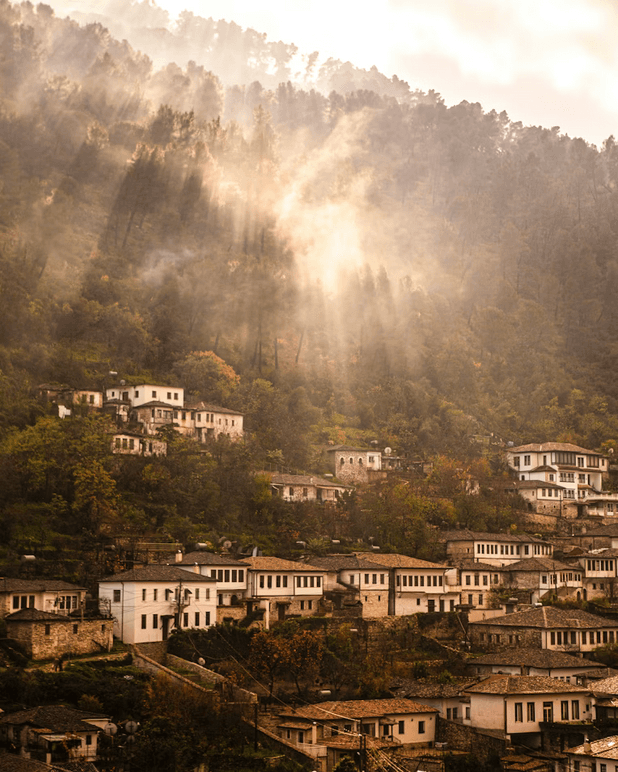
My grandfather built the kulla in 1962. A kulla is a stone tower-house, the traditional defensive structure of the northern Albanian highlands, built thick enough to withstand a rifle and positioned to see all the approaches to the family land. The Kanun — the medieval code of law that governed highland life for centuries — specified exactly how a kulla should be built, who could enter, and under what circumstances a man could leave it safely. Blood feuds kept families locked inside some kullas for years.
We use ours as a guesthouse now. Twelve beds, a wood-burning stove in the common room that takes the mountain cold off the evenings, a kitchen where my cousin cooks whatever was available from the garden that day plus lamb if a lamb was available. The walls are a metre thick. The windows on the upper floors are narrow — designed originally to shoot from, now just to frame views of the beech forest on the slopes opposite.

The pass
The Valbona-Theth route is the walk people come to the Albanian Alps to do. It crosses the ridge between the two valleys at around 1,800 metres, takes six to eight hours depending on how long you stop at the top, and delivers you down the other side into Valbona having covered approximately twelve kilometres of trail that feels much longer in the way that good walks always do — not from difficulty but from density, from the quantity of things that happen to your eyes and your legs and your sense of where the world's edges are.
The first two hours climb through beech and fir, the trail marked by stone cairns and paint on rocks. The treeline ends abruptly at around 1,500 metres and the walk becomes something different — exposed, the whole valley visible behind you, the ridge ahead still seeming a long way up. At the saddle, on a clear day, you can see into both valleys simultaneously, which is one of the better views in Europe and is not marketed nearly enough.
The Blue Eye of Theth
An hour's walk from the kulla, through the forest on the valley floor, is the Syri i Kaltër — the Blue Eye of Theth, a spring that pushes up from underground through a pool of impossible depth and colour. The water temperature never rises above 10 degrees regardless of season. People swim in it anyway. This says something about Albanians, or possibly just about the summer heat.
The colour is caused by the depth — the pool is more than 50 metres down in the centre — and the angle of the light, and some property of the limestone geology that I have had explained to me three times and still cannot accurately summarise. The effect, whatever the cause, is of looking into something that has no bottom and doesn't need one.
“The Blue Eye pushes up from underground through a pool of impossible depth. People swim in it anyway. The water is never above 10 degrees.”
The third morning
On the third morning I woke before four and went outside. The valley was completely dark — no light pollution reaches Theth, or almost none — and the sky was doing what mountain skies do when they have room to do it properly. The Milky Way was directly overhead. The peaks were just visible as a slightly darker darkness than the sky.
And then the bells again. Coming from the direction of the upper pastures this time, the flock heading somewhere I couldn't see, the shepherd presumably with them, working in the dark in the mountains in a valley where people have worked in the dark in the mountains for as long as there have been people to do it.
I stood outside for twenty minutes. By the time I went back inside I had completely lost track of what century it was, which is exactly the right way to spend time in Theth.
Ardit Gjoni's family has run the Gjoni kulla guesthouse in Theth for three generations. He leads our Albanian Alps tours from June to October.